

What the great X exodus means for your digital strategy

And why the decision about where to show up is harder than it looks…
Something has shifted in how organisations think about social media. It is no longer simply a question of where your audience is, it is a question of what being on a platform says about you, and whether the answer to that question is one you are comfortable with.
Over the past 18 months, a steady stream of organisations have been stepping away from X, (formerly Twitter).
Charities, unions, and public sector bodies and many mission-led organisations have each made the same calculation and arrived at the same conclusion: staying had begun to feel like a statement in itself.
What has been happening on X
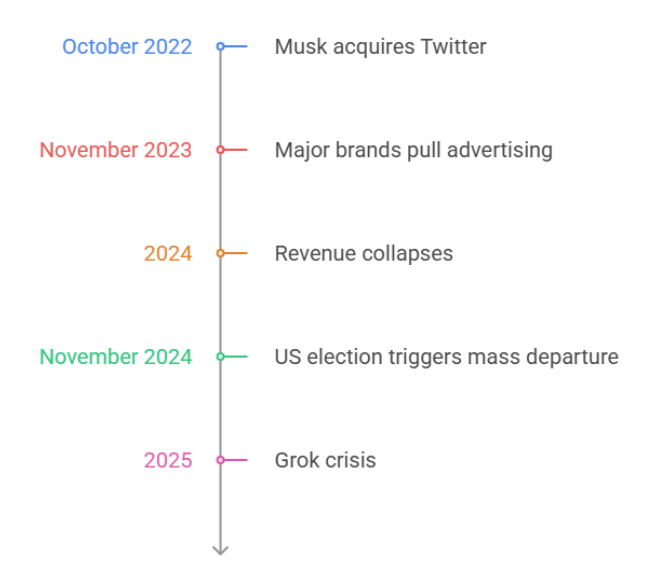
Timeline of X controversies.
Bluesky grew from 10 million users in September 2024 to over 40 million by November 2025, driven by distinct spikes around the US election, Brazil's temporary X ban, and the Grok controversy.
Threads reached 320 million registered users by January 2025.
The picture is not entirely one-directional. X still reports 600 million monthly active users globally. For many organisations, particularly those with large, established followings, the practical case for an abrupt departure remains complicated.
When platform choice becomes a values statement
“Incompatible with our values”
The phrase that has appeared repeatedly across departure statements from organisations including Jisc, Care International UK, Solace and the RSPB. For mission-driven organisations especially, the tension is acute. If your purpose is to protect vulnerable people, to campaign for social justice, or to support marginalised communities, then remaining active on a platform with documented failures around safeguarding and hate speech moderation creates a contradiction that is difficult to resolve quietly.
Being on a platform is no longer a neutral choice. In 2026, it is a signal, and the question is whether you are intentional about what that signal communicates.
For B2B and professional services firms the calculus is different, but it exists. The environment you choose to operate in says something about the organisation you want to be perceived as.
The more difficult question: should you always align your platforms with your audience's values?
X still remains a key platform where public discourse starts. Journalists source stories there, thought leaders share opinions that gets quoted, and the debates that eventually become news articles, Facebook shares and Instagram memes often begin in an X thread.
For mission-led or research-led organisations, leaving means ceding that space entirely.
X's audience also skews heavily toward political discourse, media, journalism and public affairs. For some organisations, that might be the type of audience they need to be in front +of. Bluesky, by contrast, has developed a user base that Pew Research Centre describes as ‘disproportionately left-leaning’, used by people who left X for values reasons. That is a meaningful demographic difference, and it matters strategically.
The digital engagement implications
Setting the values debate to one side for a moment, the practical marketing case for X has weakened considerably, and that shift deserves to be assessed on its own terms.
In 2025, X contributes just 1.8% of social referrals globally, down from its position a few years ago as a significant traffic driver; Facebook leads at 76%, followed by Instagram, TikTok and LinkedIn. For most organisations, heavy investment in X content is increasingly difficult to justify on performance grounds alone, regardless of any other considerations. Engagement rates on X have been erratic and, for many accounts, declining. (A following of 50,000 on a platform where organic reach has been significantly reduced is worth materially less than it was three years ago.)
The organisations that have moved to Bluesky are building audiences from scratch, but those audiences are growing, and engagement data from early adopters in the charity sector suggests the quality of interaction is higher, even where the volume is lower.
The more useful question is not which platforms exist, but which one or two are generating genuine engagement with the right audience, and whether resources should be concentrated there.
What this means for SEO and AI search
Search and social are no longer separate channels. Google now indexes public Instagram content alongside YouTube and TikTok. Social posts appear in traditional search results. The platforms an organisation chooses, and the content it creates there, have direct implications for how it shows up when people search.
AI search tools, including ChatGPT, Perplexity and Google's AI Overviews, are increasingly drawing on community-generated content to construct their answers.
An analysis of 680 million AI citations found Reddit and LinkedIn consistently among the top sources across all three platforms.
YouTube appears in AI answers disproportionately often.
X, with its declining engagement and its association with low-quality and moderated-down content, is not a strong foundation for that kind of visibility.
How to make the decision
The organisations that have handled this most effectively are the ones that have treated it as a strategic question rather than a reactive one.
What does your engagement data actually show?
Where is your specific audience, not just audiences in general?
What does your mission require in terms of reach?
What are your safeguarding obligations?
What does your decision communicate, and to whom?
If you'd like support navigating these questions for your organisation, get in touch with us at info@cyberlogical.co.uk
Author, India McLean, March 2026.